Not having a television, I miss (to some extent) the kind of nonsense shows up on cable news. Whenever I go back to Kansas, I am always surprised by home much of Fox's airtime (or CNN's, though my parents don't watch that channel) is devoted to celebrity gossip and missing baby stories. Especially in this season of war, when people are a little bored with bombings, it's appalling.
So it's nice to see a news anchor who feels my pain. Via Think Progress.
Friday, June 29, 2007
News Anchors of the World Unite

Thursday, June 28, 2007
Do Cameras Makes Us Safer?
Of all the youtube videos I have seen in the last two years, the one that shook me the most was the one that captured UCLA police officers repeatedly tasering a student in their library last November. In part, my response to that video was conditioned by witnessing a similar scene of police brutality six months previous, when four friends of mine were pepper sprayed and arrested (one was tased twice) because they were verbally confrontational with a cop who had pinned a man down , handcuffed him, and then pepper sprayed him. Naturally, all four were acquitted of the piddly little crimes there were supposedly arrested for. At least in Albuquerque, such behavior by police is a form a crowd control since it is virtually impossible to hold an officer responsible for wrongful arrest, use of excessive force, or any other type of misconduct.
So when I saw this morning that skateboarders in Arkansas got photos of a cop strangling one of their friends, and video of the same cop brutalizing and arresting a few more, my heart beat immediately began to quicken. What were the skateboarders doing? Well, you know, skateboarding. And being a worried about their friend who had just been strangled by a law enforcement officer. That's a crime, you see.
This video is not nearly as brutal as the UCLA one, and I'm glad for that. But it's a good reminder for me about the potential good cell phone cameras contain. I have a general ambivalence about the proliferation of cameras in public and the extreme ease with which we are all potentially broadcast. Ambivalent because such a proliferation could portend an Orwellian surveillance state (it's not as hyperbolic as it may sound), and yet the power seems to swing both ways, since the ability to capture true acts of injustice can, and does, happen. I don't know, ultimately, whether we are better off with this technology, but I am glad that it helps keep people who brutalize others human beings in check.
Since the UCLA incident, I have been feeling the need to acquire a camera phone. I see it as a way to protect myself, and my friends, from the police, odd as that sounds. I wonder now how things would have been different if I had had one last year when my friends were arrested.
Wednesday, June 27, 2007
Wednesday Art Class
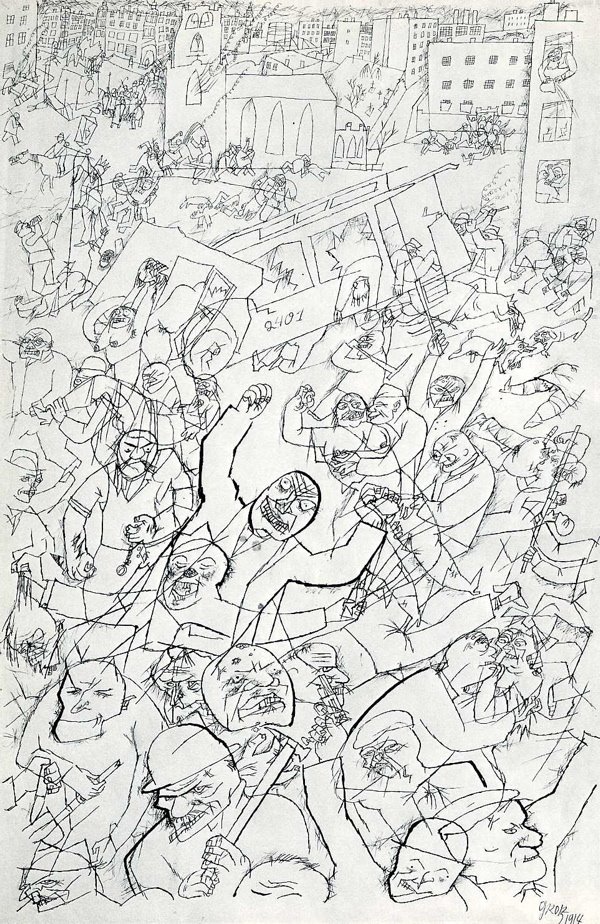
A little info on Otto Dix, the creator of this week’s image, “Prager Street.”
From Wikipedia: Otto Dix (December 2, 1891 - July 25, 1969) was a German painter and printmaker. Noted for his ruthless depictions of Weimar society and of the brutality of war, he is one of the most important artists of the Neue Sachlichkeit (New Objectivity).
Dix was an interesting character. He was a decorated German military officer during the WWI (where he was wounded several times), but made a name for himself after the war as an avant garde artist of the Dadaist sort. He was prolific through the 1920s, but was deemed a degenerate artist by the Nazis, who burned a number of his paintings. He was employed by the Nazi government to paint properly German landscapes, conscripted to serve the Motherland during WWII, captured by the French, and eventually left to live out his life in post-war Europe, where he continued to detail the lives of those that the war spared, however maimed.
 Especially impressive are Dix’s “War” etchings, which he completed in 1924, many of which can be seen here. These etchings, which are indebted to Goya's war paintings, don't flinch from the ugliness of warfare. They include depictions of ariel bombing, rape, chemical warefare, and disfigurement. As etchings, these pieces avoid the trap of over-aestheticizing --and thus glorifying--the bodies mangled by the war. (See "Meal Time in the Trenches," left.)
 The "War" etchings differ from much of Dix's output, which often features multimedia (collage) and vibrant colors. Whereas the "War" series works under an obligation to the physical reality of the times, much of Dix's work combines an adherence to the physical realities of post-war Europe with a kind of neurotic, grotesque and even nightmarish perspective that highlights the interior, psychological aspects of inter-war Europe. On the right is a painting entitled, "The Skat Players," from 1920. It depicts several military officers engaging in mundane activity--playing cards--but irrevocably disfigured. Arms, eyes, legs, noses, and even a heart are replaced by the machinery of Europe, which has atomized them.
 Even where his work is not explicitly filled by the content of war, as in his portraits, there is an uncanny oddness to his work (some great examples can be seen here). Often set amid unfamiliar backdrops, the subjects of his portraits evince a kind of inner stupidity or madness, as slumping bodies project blank expressions toward the viewer. In some paintings, we leave the sad world of the war's practitioners and enter the even sadder world of the aristocracy, whose ugliness is perhaps even more jarring than the spectacle of the victim.
Dix's work veers close to Surrealism at times, and as the years went on, he lost some of the modernist flare that gave his paintings their power. But on the whole, he left a tremendous legacy testifying to a world riven by its inability to control the the tools of modernity that it had forged.
I offer this tiny history here both for my own benefit and for the education of any readers I may have. My feeling is that we don't live in a time so different from Dix's, and that though in the Empire we aren't confronted by casualty every day, it still infects us. With just a little focussed looking, you can see it.
Dix is all over the internet, but here's one more gallery that has a nice range of his work.
Oh wait, I am the law
You probably don't need me to be the one to post this, but I'll go ahead and do it any way.
Ladies and gentlemen, I give you the second and final installment of Pearl:
Tuesday, June 26, 2007
In battle of the titans, Paris ousts Michael Moore: CNN officiates
Now let's get one thing perfectly straight: I'm not the kind of person who gets excited about celebrity news. It's just not part of my constitution. And as much as I hate to add to the already distressing amount of blog chatter about Paris Hilton and her infinitesimally short prison stint, I did find this one small detail in the BBC story rather interesting:
The 26-year-old, sentenced to 45 days on 3 June, was released early due to crowded jail conditions and time off for good behaviour.
She is scheduled to appear on Larry King's CNN talk show on Wednesday.
The network has said she will not be paid for her appearance, which has replaced a planned interview with filmmaker Michael Moore.
Good job, CNN. Michael Moore probably didn't have anything important or titillating to say, anyways.
Tuesday Links

I'm thrice an uncle,
as of 12:36 central time yesterday.
I present Samuel Wientzen Schafer, and a kickin' batch of links.
Boingboing and my friend Amar are linking to a paper on class division, as seen through Myspace and Facebook.
Gerry Canavan has got a fun link to The Perry Bible Fellowship that's worth checking out.
Also, Drag City Records is promoting Neil Hamburger, who is touring the south right now. Here's a clip of the man on the Jimmy Kimmel show, as well as one of him telling off a couple of hecklers at a show. Warning: neither of the clips are work-safe, and the first contains the crassest Michael Jackson joke I have ever heard, which is really saying something.
Monday, June 25, 2007
The Rushdie Affair -- Are We Still Having This Conversation?
Sadly, yes, the conversation goes on. It has been a 18 years since Ayatollah Khomeini issued a fatwa calling on all Muslims to execute those involved in the publication of Salman Rushdie's The Satanic Verses. It's been another 9 years since the Iranian government publicly declared that it would not carry out the death sentence against Rushdie. And then, ten days ago, England awarded Rushdie knighthood, and tempers flared again, when Pakistan remonstrated against the act and the Islamabad Traders' Association offered a reward of 10 million Pakistani rupees for Rushdie's beheading.
Now, I've never really understood what all the fuss was about. I chalk this up to two factors: 1) I am not Muslim, 2) I had no context for understanding the fuss when I read the book five years ago. But recently I started to think about the standard Western response to Pakistani anger -- the argument that holds that the book should exist on the grounds of free speech alone. And I am starting to wonder how true that is. Should it exist? I ask this question as a big Rushdie fan and someone who still doesn't quite understand how and why it has garnered the vitriol it has.
I think the only way to make this question meaningful for Westerners is to try to move it into a different domain, one where it might have a more comparable resonance. It does not, in my opinion, have any traction as a parallel to question whether an anti-Judeo Christian novel would provoke such anger. Obviously, it wouldn't, since insults to traditionally Western faiths are not dealt with in the same way as they are in Islam. Perhaps a better parallel, one which would provoke comparable anger in the United States, would be a novel about race. Would a powerfully written, best selling neo-nazi novel--one that wins the highest awards and whose author is publicly congratulated at the highest levels--be a more apt comparison? Is The Satanic Verses hate speech? Is it the rough equivalent of, say, The Turner Diaries?
Readers over at Al Jazeera English are talking about whether England should revoke Rushdie's knighthood. I offer this link not because I think England should necessarily take back the honor, but because the variety of responses offered by readers serves as a powerful insight into what that book actually means, and why, 18 years after the famous fatwa was issued, we're still talking about Rushdie.
Friday, June 22, 2007
Because some people don't want warts
 I am sometimes surprised by what doesn't make the news.
According to the good people at Feministe, Abstinence-only sex education funding has been cut.
Score one for the sane.
Thursday, June 21, 2007
This bag of placentas is so heavy!
Because I know you were wondering:
- 1 baby grand piano weighs about as much as 151 placentas
- It would take about 900 human tongues to go end zone to end zone on a football field
- It would take just over 391,111 Oscar Meyer Weinermobiles to line the Oregon Trail
- 5.6 million human eyeballs weighs about as much as one blue whale.
The Kansas-Malaysia Connection
 This comes from one of Cynical-C's favorite blogs, Strange Maps. Here's the scoop:
The creator of this map has had the interesting idea to break down that gigantic US GDP into the GDPs of individual states, and compare those to other countries’ GDP. What follows, is this slightly misleading map – misleading, because the economies both of the US states and of the countries they are compared with are not weighted for their respective populations.
Pakistan, for example, has a GDP that’s slightly higher than Israel’s – but Pakistan has a population of about 170 million, while Israel is only 7 million people strong. The US states those economies are compared with (Arkansas and Oregon, respectively) are much closer to each other in population: 2,7 million and 3,4 million.
Wednesday, June 20, 2007
More Atheism. Alright!
In addition to the slew of new books that challenge the neo-religiosity of America, we can add The Atheist's Bible by Joan Konner. It appears from this excellent review that it is in all seriousness a Proverbs-esque collection of aphorisms, including the following:
Aristotle: "men create the gods after their own images"
Schopenhauer: "Religions are like glow-worms. They need darkness in order to shine."
Santayana: "Fear first created the gods."
What a book like this offers, as the review notes, is that it has the kind of check out lane appeal that could make it a big seller. But beyond this, a book like this excells insofar as it is not an argument. The debate about belief is a doomed debate because by its very nature must rely on non-empirical information, and Konner's book doesn't try to say that religion is bogus or the biggest source of violence in history, or anything like that. Instead, it attempts to build no case where no case can be built. Fragments often have the uncanny ability to communicate more than can be stated in the most well-reasoned and articulate discourses. As Wyndham Lewis wrote about Virginia Woolf in Men Without Art, "We must reconcile ourselves to a season of failures and fragments. We must reflect that where so much strength is spent on finding a way of telling the truth the truth itself is bound to reach us in rather an exhausted and chaotic condition."
Why I haven't blogged in a week
An expected series of unfortunate events has rendered me unable to blog in the past couple of days. First, my good friend, Chris Hentzen, died suddenly of heart failure, which prompted a trip home to Kansas City. Upon returning to the Dirty Durham, I was dismayed to sense the beginnings of a serious cold, which has made my first day at the library in a week little more than a prolonged and uncomfortable nap.
As unhappy it is to have to bury a friend, especially a young one, my trip back to the City of Fountains wasn't without its upsides. For one, it was nice to be with my old friends, reminiscing about the old days, going through old photos, and watching hours of (painful) videos from high school parties. I was also fortunate that my unexpected trip brought me into to town for Bloomsday, which I spent at the always delightful Bloomsday Books, where I sat and listened, appropriately enough, to a reading of the "Hades" episode. I also picked up a John Banville novel, which I am very much looking forward to reading. And in blog news, my friend Jack Barry alerted me to the existence of a blog named Phoneless Cord, written by our friend Rachel, which I will be stealing content from soon.
More content to come once my body heals itself.
Subscribe to:
Posts (Atom)