"I'll just put it this way: if you love lead paint from China, you'll love the Republican deregulation agenda."
Friday, July 16, 2010
Quote of the Day
Posted by
Tim
at
1:38 PM
0
comments
Monday, December 17, 2007
Art Class
Things are a bit slow in the blog-world today, and I'm not feeling especially ambitious today, so I will content myself with a simple art-related post.
Awhile back I did a couple of posts on modernist painters that I fully intended to make a routing, but I've fallen off the bandwagon, so to speak. Back then, I had intended to do a post on de Chirico, whose landscape paintings are eerie and somehow fascist in feeling. Rather than playing as the art critic today, I'll just post a link to his wiki page and bunch of images. Enjoy.
Giorgio de Chirico (July 10, 1888 – November 20, 1978) also known as Népo, was an influential pre-Surrealist Greek-Italian painter born in Volos, Greece, to a Genovese mother and a Sicilian father. He founded the scuola metafisica art movement.
Posted by
Tim
at
4:05 PM
0
comments
Labels: art, de Chirico, painting
Tuesday, July 10, 2007
Art Class - George Grosz
I plan tomorrow to write the follow-up to Friday's post on punk rock careerism. In the meantime, I give you another installment of Art Class.
This week's bitter laughter image, entitled "Suicide," comes from George Grosz (1893-1959).
Like last Otto Dix, the subject of the last Art Class installment, Grosz was a participant in the First World War, an experience that was to leave a lasting mark upon his art. After the war, Grosz joined the German Communist Party (KPD), but left a year later after visitng Russia, where he met both Trotsky and Lenin.
The 1920s saw Grosz's art work destroyed (like Dix) after he allegedly insulted the German army. In order to escape the rule of the Nazis, Grosz left Germany in 1932, settling in New York, where he stayed until the final days of his life. He became a naturalized citizen in the 1950s, and was elected to the American Academy of Arts and Letters in 1954.
Grosz's art resembles Dix's in its content. Largely Grosz is remembered as a satirist ofWeimar Germany and his unflinching look at its people. His early work has all the formal bravado of Dada, but what makes him perhaps distinctive from the diverse array of talented modernists working Berlin in the 1920s is that his work seems at times prescient of the imminent comeuppance of another art form--the cartoon. The way in which Grosz deploys the charicature, however, prevents most viewers from assimilating his human forms to that medium, largely because the backgrounds of these paintings contextualize the people in them in such a way that the flatness of the people is not immediately legible. This is seen best in "Grey Day" (1921) and "Republican Automatons" (1920). In "Grey Day," (left) a worker, maimed soldier, business man, and a fourth figure stand are set amid a factory setting. The human figures are given exaggeratedly different features; while the soldier is more or less realistically portrayed, the worker is faceless--a mere geometry. The two walking figures move in direct lines to the left and right of the canvas, and though the scene has depth, it is accomplished despite the flatness of these movements. The flatness of these characters is most bluntly put by the businessman in the foreground, who has no depth. Set amid the factoryscape, these figures and their apparent incongruity to each other is disturbing.
The cityscape is also a prominent feature in "Republican Automatons," (right) where all the human figures are overly rounded, blank mannequins. Their thoughts are fed to them, and their actions prompted by the gears at the lower right, suggesting the utter emptiness of a seemingly meaningful gesture--the waving of the flag. The city scape is again a conspicuous feature, suggesting that somehow the city is to blame for the citizenry's inability to self-actuate.
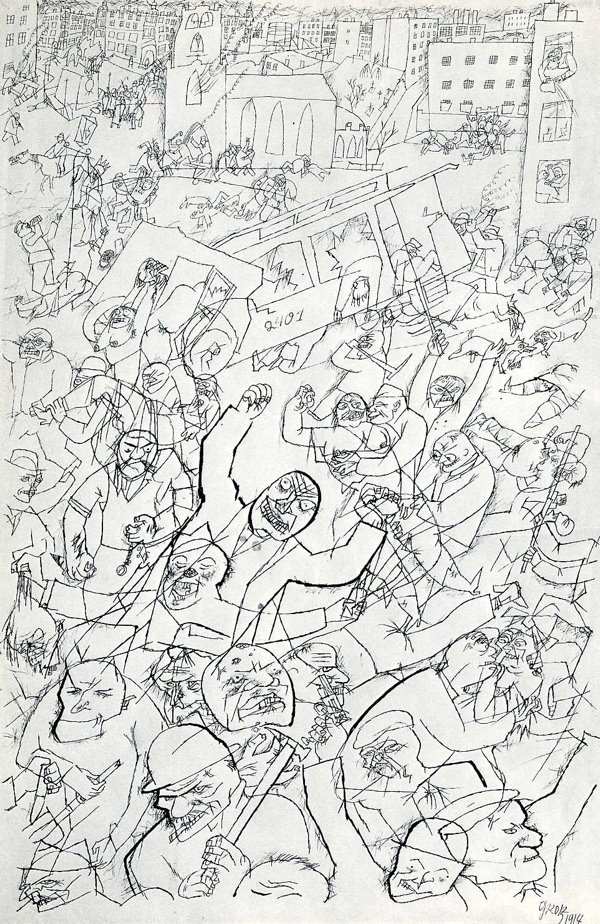
Other of Grosz's pieces that resonate with me are his drawings. Here the cartoonishness of his work really comes out, and the bleakness of the black and white brings home the utter absurdity of inter-war Germany, to say nothing of inter-war Europe as a whole.
Late in life, Grosz was to depict the Nazi era (cf. his Hitler painting, "Cain, or Hitler in Hell"), but by far his most successful work was his efforts to depict all aspects of Weimar society--soldier, socialists, prostitutes, military doctors, aristocrats, etc.
Galleries of his work can be found here, here and here.
Posted by
Tim
at
1:56 PM
0
comments
Labels: comics, George Grosz, painting, prosthesis, WWI
Wednesday, June 27, 2007
Wednesday Art Class
A little info on Otto Dix, the creator of this week’s image, “Prager Street.”
From Wikipedia: Otto Dix (December 2, 1891 - July 25, 1969) was a German painter and printmaker. Noted for his ruthless depictions of Weimar society and of the brutality of war, he is one of the most important artists of the Neue Sachlichkeit (New Objectivity).
Dix was an interesting character. He was a decorated German military officer during the WWI (where he was wounded several times), but made a name for himself after the war as an avant garde artist of the Dadaist sort. He was prolific through the 1920s, but was deemed a degenerate artist by the Nazis, who burned a number of his paintings. He was employed by the Nazi government to paint properly German landscapes, conscripted to serve the Motherland during WWII, captured by the French, and eventually left to live out his life in post-war Europe, where he continued to detail the lives of those that the war spared, however maimed.
The "War" etchings differ from much of Dix's output, which often features multimedia (collage) and vibrant colors. Whereas the "War" series works under an obligation to the physical reality of the times, much of Dix's work combines an adherence to the physical realities of post-war Europe with a kind of neurotic, grotesque and even nightmarish perspective that highlights the interior, psychological aspects of inter-war Europe. On the right is a painting entitled, "The Skat Players," from 1920. It depicts several military officers engaging in mundane activity--playing cards--but irrevocably disfigured. Arms, eyes, legs, noses, and even a heart are replaced by the machinery of Europe, which has atomized them.
Even where his work is not explicitly filled by the content of war, as in his portraits, there is an uncanny oddness to his work (some great examples can be seen here). Often set amid unfamiliar backdrops, the subjects of his portraits evince a kind of inner stupidity or madness, as slumping bodies project blank expressions toward the viewer. In some paintings, we leave the sad world of the war's practitioners and enter the even sadder world of the aristocracy, whose ugliness is perhaps even more jarring than the spectacle of the victim.Dix's work veers close to Surrealism at times, and as the years went on, he lost some of the modernist flare that gave his paintings their power. But on the whole, he left a tremendous legacy testifying to a world riven by its inability to control the the tools of modernity that it had forged.
I offer this tiny history here both for my own benefit and for the education of any readers I may have. My feeling is that we don't live in a time so different from Dix's, and that though in the Empire we aren't confronted by casualty every day, it still infects us. With just a little focussed looking, you can see it.
Dix is all over the internet, but here's one more gallery that has a nice range of his work.
Posted by
Tim
at
1:29 PM
4
comments
Labels: Otto Dix, painting, prosthesis, WWI