Showing posts with label statistics. Show all posts

Wednesday, November 9, 2011

Stats

A little Wednesday afternoon statistics, to cheer us up.

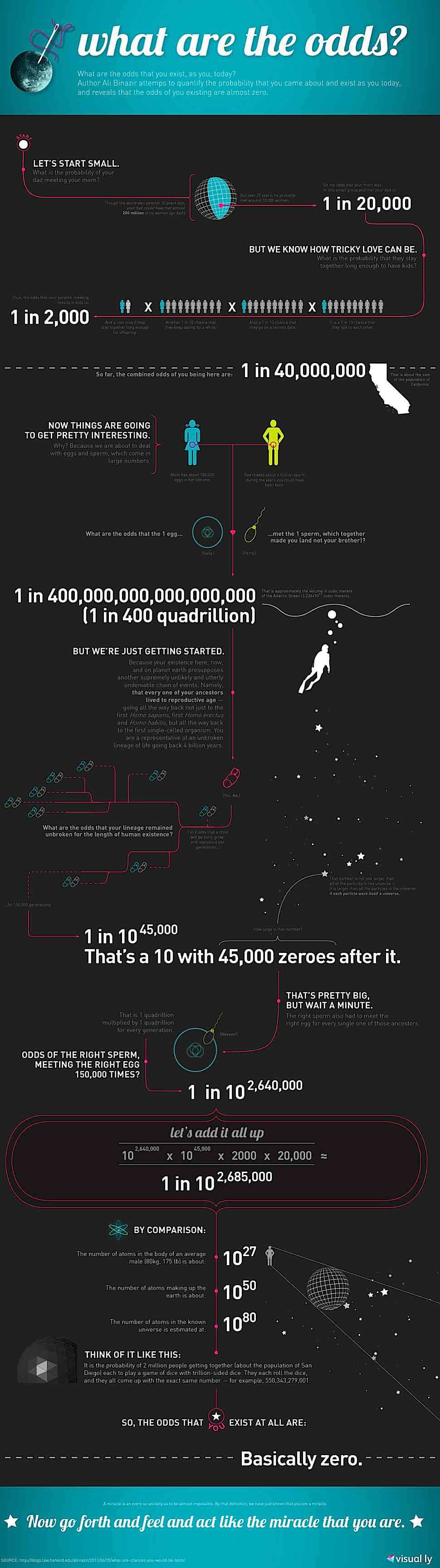
What are the odds that you, as an individual, exist? Pretty good, you'd guess, since you're sitting right here reading this. But, in an abstract sense, the chances that you exist are really rather slim.
Click here to see the whole thing--and read all the way until the end. Via BoingBoing.

Now go be a statistical miracle.


Friday, September 10, 2010

As much as statistical analyses of American political attitudes (and there's nothing more depressing than the graphs in this story), I take solace in knowing that Americans actually aren't as confused about wealth as I sometimes imagine:

A new Gallup poll shows the majority of Americans favor letting the Bush era tax cuts to expire for the wealthy. While 37% support keeping the tax cuts for all Americans, 44% want them extended only for those making less than $250,000 and 15% think they should expire for all taxpayers.
Here's the take away from Gallup:
Gallup has typically found Americans unsympathetic to the argument that upper-income Americans are overtaxed. They generally believe upper-income Americans pay too little in taxes and favor higher taxes on wealthy Americans as a means to fund government programs, such as Social Security.
Thursday, October 8, 2009

Opting in and out

Nate Silver, political gem, explains why the clause being floated that may allow states to opt out of the public option aint all that bad. Here are his first four points:

1) If the public option is indeed popular -- and the preponderance of public polling suggests that it is -- we should expect the solid majority of states to elect to retain it. Perhaps some Republican governors or legislatures would seek to override the popular will in their states -- but they would do so at their own peril (and at Democrats' gain).

2) Behavioral economics further suggests that default preferences are extremely powerful. Making the public option the default would probably lead to much greater adaptation than requiring states to "opt in".

3) If the public option indeed reduces the costs of insurance -- and most of the evidence suggests that it will -- than the states that opt out of it will have a pretty compelling reason to opt back in. Say that Kansas opts out of the public option and Missouri keeps it. If a Kansan realizes that his friend across the border is buying the same quality health insurance for $300 less per month, he's going to vote restore the public plan in a referendum or demand that his legislator does the same in Topeka.

4) Even in states that do opt out of the public option, the fact that voters could presumably elect later to restore it creates an extremely credible threat to the private insurance industry that will itself help to create price competition.
Could we really be on the verge of making this happen?

Monday, January 28, 2008

Numbers

While our fearless leaders stands in front of Congress to give his last State of the Union speech (thank god!), remember the human cost of war. From The Herald, via Cynical-C.

72,000 American casualties: toll of war on terror

The US has suffered more than 72,000 battlefield casualties since the start of the war on terror in 2001, a Freedom of Information request has revealed.

The query by the campaigning Veterans for Common Sense organisation shows that 4372 American soldiers have died and another 67,671 have been wounded in action, injured in accidents or succumbed to illness in Iraq and Afghanistan.

The veterans' group had to force the US Defence Department to release the figures by persuading judges to uphold their FoI rights.

A second request to the Veterans' Administration, the government-funded body responsible for taking care of ex-servicemen and women, showed 263,909 soldiers with experience of the two 21st-century wars have so far received treatment for everything from post-traumatic stress disorder (PTSD) to the aftermath of amputated limbs.


Thursday, June 21, 2007

This bag of placentas is so heavy!

Because I know you were wondering:

  • 1 baby grand piano weighs about as much as 151 placentas
  • It would take about 900 human tongues to go end zone to end zone on a football field
  • It would take just over 391,111 Oscar Meyer Weinermobiles to line the Oregon Trail
  • 5.6 million human eyeballs weighs about as much as one blue whale.
Sleep easy. I've got all the answers.