Now, this might come as a surprise to those of you who know that I am studying to get a PhD in English, but I didn't read that much as a kid. Usually when the topic of favorite childhood books comes up, my friends list series after series of books that they loved. To this conversation, I can add only that I enjoyed the Matt Christopher series, and when I explain that these were sports books, everyone gives me a kind of irritated look before they return to comparing their adolescent tastes and fantasies.
Mostly I went in for picture books. And there's no beating The Little Mr. and Little Miss series. So when I mentioned them to Kendra the other day (she's Little Miss Impatient, I've determined), she did a little investigatory journalism and unearthed this startling website. So they're making it into a show. I can't complain about that, because, after all, the only thing better than picture books is t.v. But what I don't understand is the marketing. The website suggests that the inteded age group is 4-7, but the humor seems more appropriate for, well, someone like me. Is it sad that I still laugh OUT LOUD when I hear cartoon characters say "poop"? I think that's all Mr. Bump says. And on the website, you can make seagulls shit on Mr. Grumpy's head. Hilarious! Oh, if only I had a t.v. In the meantime, enjoy the website. God that Mr. Grumpy's a bastard! Poop!
Update: I have seen two (TWO!) Little Ms. t-shirts in the last two days. I'm sensing a resurgence of the 1970s zeitgeist the birthed this series.
Thursday, August 23, 2007
I Know a Monkey That Needs a Tickle

Tuesday, July 10, 2007
Art Class - George Grosz
I plan tomorrow to write the follow-up to Friday's post on punk rock careerism. In the meantime, I give you another installment of Art Class.
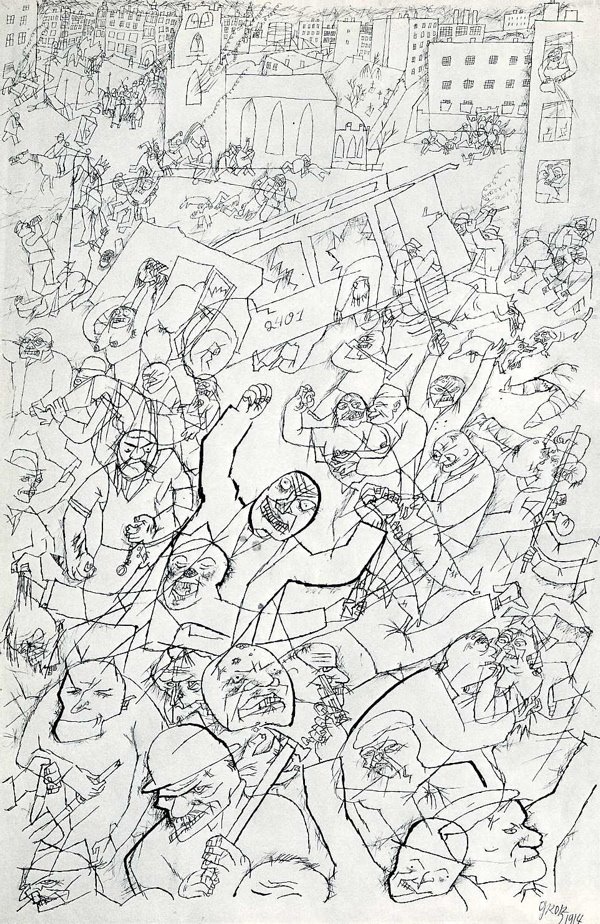
This week's bitter laughter image, entitled "Suicide," comes from George Grosz (1893-1959).
Like last Otto Dix, the subject of the last Art Class installment, Grosz was a participant in the First World War, an experience that was to leave a lasting mark upon his art. After the war, Grosz joined the German Communist Party (KPD), but left a year later after visitng Russia, where he met both Trotsky and Lenin.
The 1920s saw Grosz's art work destroyed (like Dix) after he allegedly insulted the German army. In order to escape the rule of the Nazis, Grosz left Germany in 1932, settling in New York, where he stayed until the final days of his life. He became a naturalized citizen in the 1950s, and was elected to the American Academy of Arts and Letters in 1954.
Grosz's art resembles Dix's in its content. Largely Grosz is remembered as a satirist ofWeimar Germany and his unflinching look at its people. His early work has all the formal bravado of Dada, but what makes him perhaps distinctive from the diverse array of talented modernists working Berlin in the 1920s is that his work seems at times prescient of the imminent comeuppance of another art form--the cartoon. The way in which Grosz deploys the charicature, however, prevents most viewers from assimilating his human forms to that medium, largely because the backgrounds of these paintings contextualize the people in them in such a way that the flatness of the people is not immediately legible.  This is seen best in "Grey Day" (1921) and "Republican Automatons" (1920). In "Grey Day," (left) a worker, maimed soldier, business man, and a fourth figure stand are set amid a factory setting. The human figures are given exaggeratedly different features; while the soldier is more or less realistically portrayed, the worker is faceless--a mere geometry. The two walking figures move in direct lines to the left and right of the canvas, and though the scene has depth, it is accomplished despite the flatness of these movements. The flatness of these characters is most bluntly put by the businessman in the foreground, who has no depth. Set amid the factoryscape, these figures and their apparent incongruity to each other is disturbing.
 The cityscape is also a prominent feature in "Republican Automatons," (right) where all the human figures are overly rounded, blank mannequins. Their thoughts are fed to them, and their actions prompted by the gears at the lower right, suggesting the utter emptiness of a seemingly meaningful gesture--the waving of the flag. The city scape is again a conspicuous feature, suggesting that somehow the city is to blame for the citizenry's inability to self-actuate.
Other of Grosz's pieces that resonate with me are his drawings. Here the cartoonishness of his work really comes out, and the bleakness of the black and white brings home the utter absurdity of inter-war Germany, to say nothing of inter-war Europe as a whole. Late in life, Grosz was to depict the Nazi era (cf. his Hitler painting, "Cain, or Hitler in Hell"), but by far his most successful work was his efforts to depict all aspects of Weimar society--soldier, socialists, prostitutes, military doctors, aristocrats, etc.
Galleries of his work can be found here, here and here.
Tuesday, June 26, 2007
Tuesday Links

I'm thrice an uncle,
as of 12:36 central time yesterday.
I present Samuel Wientzen Schafer, and a kickin' batch of links.
Boingboing and my friend Amar are linking to a paper on class division, as seen through Myspace and Facebook.
Gerry Canavan has got a fun link to The Perry Bible Fellowship that's worth checking out.
Also, Drag City Records is promoting Neil Hamburger, who is touring the south right now. Here's a clip of the man on the Jimmy Kimmel show, as well as one of him telling off a couple of hecklers at a show. Warning: neither of the clips are work-safe, and the first contains the crassest Michael Jackson joke I have ever heard, which is really saying something.