Showing posts with label Otto Dix. Show all posts

Monday, January 14, 2008

Scar Tissue

Ryan Vu sends along a link from Dennis Cooper's blog, The Weaklings, about facial prosthesis in WWI, a topic that Bitter Laughter broached early in its life. This post has a number of nice images, but I should warn you that they are a bit gory. To the right is an Otto Dix painting showing a facial injury.

The officers had a hard time explaining the concept of a machine gun or the power of an artillery shell to young soldiers who hadn't seen them. A soldier might stick his head out quickly to peek over the trench wall and get his nose shot off, or his chin or his cheek or his eyes and so on. This was a common occurrence on the front. Doctors had no idea how to deal with this swell of facial injuries.

These soldiers were called "The Men with Broken Faces" or "gueules cassées". There were so many of them during and after the war that in some combatant countries, a number of benches were painted blue indicating that the man sitting there would be distressing to look at. They endured total social isolation and alienation. Their faces were taken away from them and transformed on the battlefield to resemble the mud-churned pits of the trenches themselves. These men were the quintessential social pariahs of the day, not only for their specific disfigurement, but because their faces directly embodied the horrors of war and quite literally bore the inescapable reality of what we are capable of doing to each other. They often only found solace in each other and gave up any hope of leading a normal life. A unique brotherhood was formed where they pressed for their right to have underground social places of their own where they could be together without frightening the general public. Some of the veterans even took their families and started their own small communities far away from general society.
Part of what fascinates me about the facial prosthesis of the "Great" War is that it is in some ways the most extreme and spectacular form of prosthesis that proliferated after the war. I think it's hard to recover just how mended the streets of Europe looked in the mid 1920s--how many people would have donned crutches, fake arms, etc. But what's really striking about the facial prosthesis is that it is a cipher of the insane distance that science created between technologies of destruction and technologies of reconstruction. WWI inaugurated the century of technology and technological warfare, and the facial prosthesis that followed the war is a sign of just how gruesome this war was. And since we tend to think of World Wars through one of two images--mushroom clouds or gas chambers--the image of the reconstructed face is a reminder of all those figures that physically survived into the century, carrying the wounds of Continent on their bodies.

Wednesday, June 27, 2007

Wednesday Art Class

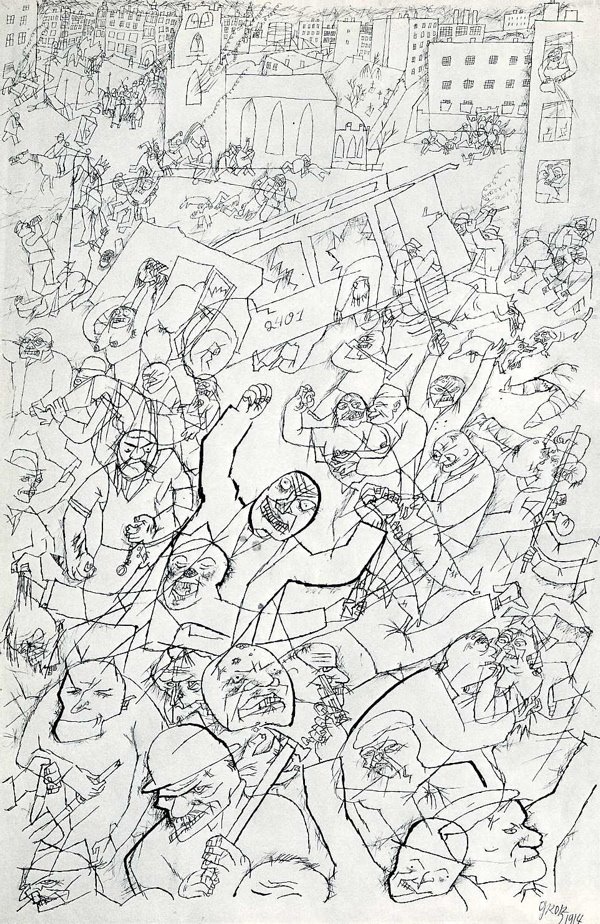
A little info on Otto Dix, the creator of this week’s image, “Prager Street.”

From Wikipedia: Otto Dix (December 2, 1891 - July 25, 1969) was a German painter and printmaker. Noted for his ruthless depictions of Weimar society and of the brutality of war, he is one of the most important artists of the Neue Sachlichkeit (New Objectivity).

Dix was an interesting character. He was a decorated German military officer during the WWI (where he was wounded several times), but made a name for himself after the war as an avant garde artist of the Dadaist sort. He was prolific through the 1920s, but was deemed a degenerate artist by the Nazis, who burned a number of his paintings. He was employed by the Nazi government to paint properly German landscapes, conscripted to serve the Motherland during WWII, captured by the French, and eventually left to live out his life in post-war Europe, where he continued to detail the lives of those that the war spared, however maimed.

Especially impressive are Dix’s “War” etchings, which he completed in 1924, many of which can be seen here. These etchings, which are indebted to Goya's war paintings, don't flinch from the ugliness of warfare. They include depictions of ariel bombing, rape, chemical warefare, and disfigurement. As etchings, these pieces avoid the trap of over-aestheticizing --and thus glorifying--the bodies mangled by the war. (See "Meal Time in the Trenches," left.)

The "War" etchings differ from much of Dix's output, which often features multimedia (collage) and vibrant colors. Whereas the "War" series works under an obligation to the physical reality of the times, much of Dix's work combines an adherence to the physical realities of post-war Europe with a kind of neurotic, grotesque and even nightmarish perspective that highlights the interior, psychological aspects of inter-war Europe. On the right is a painting entitled, "The Skat Players," from 1920. It depicts several military officers engaging in mundane activity--playing cards--but irrevocably disfigured. Arms, eyes, legs, noses, and even a heart are replaced by the machinery of Europe, which has atomized them.

Even where his work is not explicitly filled by the content of war, as in his portraits, there is an uncanny oddness to his work (some great examples can be seen here). Often set amid unfamiliar backdrops, the subjects of his portraits evince a kind of inner stupidity or madness, as slumping bodies project blank expressions toward the viewer. In some paintings, we leave the sad world of the war's practitioners and enter the even sadder world of the aristocracy, whose ugliness is perhaps even more jarring than the spectacle of the victim.


Dix's work veers close to Surrealism at times, and as the years went on, he lost some of the modernist flare that gave his paintings their power. But on the whole, he left a tremendous legacy testifying to a world riven by its inability to control the the tools of modernity that it had forged.

I offer this tiny history here both for my own benefit and for the education of any readers I may have. My feeling is that we don't live in a time so different from Dix's, and that though in the Empire we aren't confronted by casualty every day, it still infects us. With just a little focussed looking, you can see it.

Dix is all over the internet, but here's one more gallery that has a nice range of his work.