Showing posts with label WWI. Show all posts

Tuesday, June 3, 2008

its war, war, and the environment. get used to it.

Highlights from the Harper's Weekly (with links!):

Sunday, January 20, 2008

Old

Just the other day, my friend Mitch was telling me that by the end of the year, the United States will likely have only one living veteran of the First World War. And today I saw this on the BBC:

France's oldest WW1 veteran dies

One of the last two surviving French veterans of World War I has died at the age of 110.

Louis de Cazenave, who fought in the Battle of the Somme in 1916, died in his sleep at his home in Brioude, central France, his son Louis said.

Mr de Cazenave's death leaves Lazare Ponticelli, also 110, as the last "poilu", or French WWI veteran.

You probably feel the way about this that I did--surprise that there are any surviving veterans. Wikipedia has a full entry on the remaining veterans, though it should be noted that many of those who are "veterans" never saw action, or, in the case of the US soldiers, ever set foot on the continent.

Update: Mitch informs me that we just lost a WWI veteran.

Monday, January 14, 2008

Scar Tissue

Ryan Vu sends along a link from Dennis Cooper's blog, The Weaklings, about facial prosthesis in WWI, a topic that Bitter Laughter broached early in its life. This post has a number of nice images, but I should warn you that they are a bit gory. To the right is an Otto Dix painting showing a facial injury.

The officers had a hard time explaining the concept of a machine gun or the power of an artillery shell to young soldiers who hadn't seen them. A soldier might stick his head out quickly to peek over the trench wall and get his nose shot off, or his chin or his cheek or his eyes and so on. This was a common occurrence on the front. Doctors had no idea how to deal with this swell of facial injuries.

These soldiers were called "The Men with Broken Faces" or "gueules cassées". There were so many of them during and after the war that in some combatant countries, a number of benches were painted blue indicating that the man sitting there would be distressing to look at. They endured total social isolation and alienation. Their faces were taken away from them and transformed on the battlefield to resemble the mud-churned pits of the trenches themselves. These men were the quintessential social pariahs of the day, not only for their specific disfigurement, but because their faces directly embodied the horrors of war and quite literally bore the inescapable reality of what we are capable of doing to each other. They often only found solace in each other and gave up any hope of leading a normal life. A unique brotherhood was formed where they pressed for their right to have underground social places of their own where they could be together without frightening the general public. Some of the veterans even took their families and started their own small communities far away from general society.
Part of what fascinates me about the facial prosthesis of the "Great" War is that it is in some ways the most extreme and spectacular form of prosthesis that proliferated after the war. I think it's hard to recover just how mended the streets of Europe looked in the mid 1920s--how many people would have donned crutches, fake arms, etc. But what's really striking about the facial prosthesis is that it is a cipher of the insane distance that science created between technologies of destruction and technologies of reconstruction. WWI inaugurated the century of technology and technological warfare, and the facial prosthesis that followed the war is a sign of just how gruesome this war was. And since we tend to think of World Wars through one of two images--mushroom clouds or gas chambers--the image of the reconstructed face is a reminder of all those figures that physically survived into the century, carrying the wounds of Continent on their bodies.

Monday, July 23, 2007

The 9-11 Generation

After reading the title volume of Pat Barker's Regeneration Trilogy, I've been a little preoccupied with the thinking about the Iraq war, or rather how we tend not to think about the Iraq war.

Barker's novel opens with a "Statement against the continuation of the War"--an actual document penned in 1917 by Siegfied Sassoon, the real-life protagonist of Barker's historical novel. Sassoon's argument against the war was two-fold: (1) that England's aims in WWI had changed over time, rendering the war not one of "defense and liberation," but "a war of aggression and conquest;" and (2) that the war was being supported by a complacent populace that did not share in the agonies of the war and had not "sufficient imagination to realize" such agonies.

It is Sassoon's later point that continues to plague me--namely that war, when practiced by the most powerful, need not affect the populace supporting the bloodshed. Sassoon may have been overstating his point in 1917 (after all, the British were subject to night raids and lost nearly 1 million lives over the course of the war), but his point--that the citizenry had no ability to appreciate the carnage and were thus complacent in supporting the war--still stands. And if anything, his argument has more resonance today in 2007 than it did in 1917.

Glenn Greenwald has this in mind over at Salon.com, where's he's thinking about the identity of the '9-11 Generation.' What is the most fundamental attribute of the '9-11 Generation'? Greenwald nails it:

the unprecedented ease with which one can cheer on endless wars without having to make even the most minimal sacrifices to sustain them.
Greenwald is engaging in this article with the right wing's idea that my generation has met the specter of war with more courage than my parents' since we didn't storm the streets in order to end this thing (shame on us). Greenwald takes this argument to pieces, but his larger point I think still stands: that we are a people (and a generation) so little concerned with the violence practiced in our name, that our detachment from the real state of affairs has become one of our fundamental characteristics. Not only does such "callous complacence" (as Sassoon put it) reflect our failures of empathy (for our own and others) but it is dangerous. Isn't it our inability to feel for others (for the Other) that got us here in the first place? And by "here" I mean embroiled in a series of badly executed, prolonged and unproductive wars in the middle east. Might our inability to register and react to this war ethically be our undoing?

Update: Greenwald has a nice link to a video about this topic, entitled Generation Chickenhawk: the Unauthorized College Republican Convention Tour, which is worth checking out.

Tuesday, July 17, 2007

Adding Color to WWI

I intend at some point to write some brief reviews of books I've read this summer, including the the title volume of Pat Barker's Regeneration trilogy, a series of historical novels that explore the psychic and physical traumas of WWI. Also, I hope to watch and review a documentary I just picked up, WWI in Color, a narrated look at WWI news footage to which color has been added.

Today's link is of a similar cast as that documentary--a look at images from a particular battle after color has been added. Why people feel that adding color to black and white is a cool or even necessary task escapes me. It's as if the viewer wouldn't get it unless they could see that, yes, gas masks are green and mud puddles are brown. In any event, these photos are pretty amazing, as most photos of the war are. More to come on this topic.

From The Daily Mail:

Never seen before, these astonishing photographs, lovingly hand-touched in colour to bring to life the nightmare of Passchendaele, were released this week to commemorate the 90th anniversary of the battle that, between July and November 1917, claimed a staggering 2,121 lives a day and in total some quarter of a million Allied soldiers.


Tuesday, July 10, 2007

Art Class - George Grosz

I plan tomorrow to write the follow-up to Friday's post on punk rock careerism. In the meantime, I give you another installment of Art Class.

This week's bitter laughter image, entitled "Suicide," comes from George Grosz (1893-1959).

Like last Otto Dix, the subject of the last Art Class installment, Grosz was a participant in the First World War, an experience that was to leave a lasting mark upon his art. After the
war, Grosz joined the German Communist Party (KPD), but left a year later after visitng Russia, where he met both Trotsky and Lenin.
The 1920s saw Grosz's art work destroyed (like Dix) after he allegedly insulted the German army. In order to escape the rule of the Nazis, Grosz left Germany in 1932, settling in New York, where he stayed until the final days of his life. He became a naturalized citizen in the 1950s, and was elected to the American Academy of Arts and Letters in 1954.

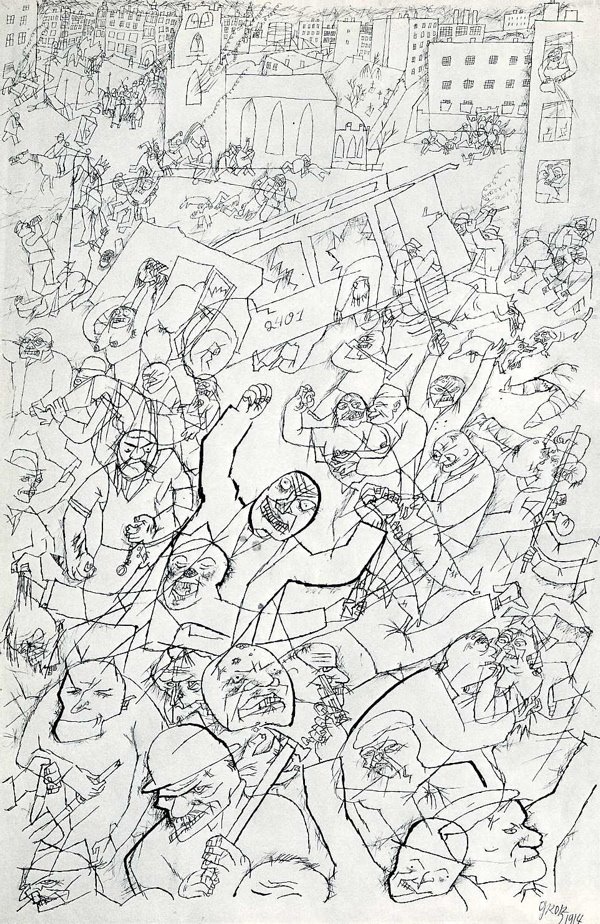
Grosz's art resembles Dix's in its content. Largely Grosz is remembered as a satirist ofWeimar Germany and his unflinching look at its people. His early work has all the formal bravado of Dada, but what makes him perhaps distinctive from the diverse array of talented modernists working Berlin in the 1920s is that his work seems at times prescient of the imminent comeuppance of another art form--the cartoon. The way in which Grosz deploys the charicature, however, prevents most viewers from assimilating his human forms to that medium, largely because the backgrounds of these paintings contextualize the people in them in such a way that the flatness of the people is not immediately legible.
This is seen best in "Grey Day" (1921) and "Republican Automatons" (1920). In "Grey Day," (left) a worker, maimed soldier, business man, and a fourth figure stand are set amid a factory setting. The human figures are given exaggeratedly different features; while the soldier is more or less realistically portrayed, the worker is faceless--a mere geometry. The two walking figures move in direct lines to the left and right of the canvas, and though the scene has depth, it is accomplished despite the flatness of these movements. The flatness of these characters is most bluntly put by the businessman in the foreground, who has no depth. Set amid the factoryscape, these figures and their apparent incongruity to each other is disturbing.
The cityscape is also a prominent feature in "Republican Automatons," (right) where all the human figures are overly rounded, blank mannequins. Their thoughts are fed to them, and their actions prompted by the gears at the lower right, suggesting the utter emptiness of a seemingly meaningful gesture--the waving of the flag. The city scape is again a conspicuous feature, suggesting that somehow the city is to blame for the citizenry's inability to self-actuate.
Other of Grosz's pieces that resonate with me are his drawings. Here the cartoonishness of his work really comes out, and the bleakness of the black and white brings home the utter absurdity of inter-war Germany, to say nothing of inter-war Europe as a whole.

Late in life, Grosz was to depict the Nazi era (cf. his Hitler painting, "Cain, or Hitler in Hell"), but by far his most successful work was his efforts to depict all aspects of Weimar society--soldier, socialists, prostitutes, military doctors, aristocrats, etc.

Galleries of his work can be found here, here and here.

Wednesday, June 27, 2007

Wednesday Art Class

A little info on Otto Dix, the creator of this week’s image, “Prager Street.”

From Wikipedia: Otto Dix (December 2, 1891 - July 25, 1969) was a German painter and printmaker. Noted for his ruthless depictions of Weimar society and of the brutality of war, he is one of the most important artists of the Neue Sachlichkeit (New Objectivity).

Dix was an interesting character. He was a decorated German military officer during the WWI (where he was wounded several times), but made a name for himself after the war as an avant garde artist of the Dadaist sort. He was prolific through the 1920s, but was deemed a degenerate artist by the Nazis, who burned a number of his paintings. He was employed by the Nazi government to paint properly German landscapes, conscripted to serve the Motherland during WWII, captured by the French, and eventually left to live out his life in post-war Europe, where he continued to detail the lives of those that the war spared, however maimed.

Especially impressive are Dix’s “War” etchings, which he completed in 1924, many of which can be seen here. These etchings, which are indebted to Goya's war paintings, don't flinch from the ugliness of warfare. They include depictions of ariel bombing, rape, chemical warefare, and disfigurement. As etchings, these pieces avoid the trap of over-aestheticizing --and thus glorifying--the bodies mangled by the war. (See "Meal Time in the Trenches," left.)

The "War" etchings differ from much of Dix's output, which often features multimedia (collage) and vibrant colors. Whereas the "War" series works under an obligation to the physical reality of the times, much of Dix's work combines an adherence to the physical realities of post-war Europe with a kind of neurotic, grotesque and even nightmarish perspective that highlights the interior, psychological aspects of inter-war Europe. On the right is a painting entitled, "The Skat Players," from 1920. It depicts several military officers engaging in mundane activity--playing cards--but irrevocably disfigured. Arms, eyes, legs, noses, and even a heart are replaced by the machinery of Europe, which has atomized them.

Even where his work is not explicitly filled by the content of war, as in his portraits, there is an uncanny oddness to his work (some great examples can be seen here). Often set amid unfamiliar backdrops, the subjects of his portraits evince a kind of inner stupidity or madness, as slumping bodies project blank expressions toward the viewer. In some paintings, we leave the sad world of the war's practitioners and enter the even sadder world of the aristocracy, whose ugliness is perhaps even more jarring than the spectacle of the victim.


Dix's work veers close to Surrealism at times, and as the years went on, he lost some of the modernist flare that gave his paintings their power. But on the whole, he left a tremendous legacy testifying to a world riven by its inability to control the the tools of modernity that it had forged.

I offer this tiny history here both for my own benefit and for the education of any readers I may have. My feeling is that we don't live in a time so different from Dix's, and that though in the Empire we aren't confronted by casualty every day, it still infects us. With just a little focussed looking, you can see it.

Dix is all over the internet, but here's one more gallery that has a nice range of his work.

Friday, June 8, 2007

Body Artist

I just finished writing a paper on prosthesis in Russia in the 1920s, so I've been thinking a lot about body extension, the various binding/liberating qualities to modern technology. So following on yesterday's WWI art post, I thought I'd add an image from and link to a Smithsonian article on facial prosthesis.


"Wounded tommies facetiously called it "The Tin Noses Shop." Located within the 3rd London General Hospital, its proper name was the "Masks for Facial Disfigurement Department"; either way, it represented one of the many acts of desperate improvisation borne of the Great War, which had overwhelmed all conventional strategies for dealing with trauma to body, mind and soul. On every front—political, economic, technological, social, spiritual—World War I was changing Europe forever, while claiming the lives of 8 million of her fighting men and wounding 21 million more."

Thursday, June 7, 2007

Faces of War

Cynical-C has a link up today to a nice site hosted by the University of Victoria, which contains the drawings and water colors of an anonymous British soldier in the First World War.

It's hard not to think of Agamben and Guantanamo when you look at these pictures: